
The Ancient 8.
There are 8 scenarios most investors need to consider. A review of where these 8 scenarios stand.

By and large investors need to consider three dimensions when deciding how to allocate their savings. Those dimensions are growth, inflation, and whether fiat cash or assets are a better deal. The last one is tricky but is meant to be an outlook on whether monetary and fiscal conditions are going to be easier or tighter in the future regardless of the first two dimensions.
When deciding how to invest, the level of each of these things is not particularly important to know with certainty it’s the expectations priced in relative to what will ultimately transpire and how those expectations will shift along the way.
Priors
Absent some sort of Time Machine it’s a decent operating assumption that current pricing of all assets reflects consensus expectations of all investors regarding the future of these 3 dimensions.
It’s also a decent basic operating assumption that those who want cash to consume or invest in the real economy (spenders) are forced to pay a risk premium to savers who buy the assets they spenders sell because savers have the cash and spenders must compete for it. This risk premium can change radically as savings and spending is a supply and demand for cash but is pretty unlikely to ever be so low that over the long term investors don’t get paid a risk premium Holding a diversified portfolio of assets is highly likely to outperform cash. “Always Own Beta” is how I solve that point.
Optimism
When discussing the Ancient 8 concept there is a tendency for me and for most people to be optimistic. I look at the short, medium, and long term history of society and the fantastic accomplishments we have made and believe strongly that the Human Race is capable of doing incredible things to improve our standard of living. Has the improvement in local and global standard of living been unequal? Has it consumed resources irresponsibly and impacted the planet? Has it been built on debt? Sure. But I remain optimistic about the future ability of the human race to improve its standard of living (including by greedily adding debt, having further unequal distribution of the improvement and destroying our planet if necessary). The parenthetical is for an ethics substack perhaps Not my lane My point is I am a real growth optimist and perhaps even more so a United States real growth optimist. I am a biased citizen of the U.S. and think our geographical moat, our democracy, and our culture, are more likely to deliver future real growth than other countries. With all that said I suspect I am somewhat more optimistic about global real growth and U.S. specific real growth than most readers BUT that doesn’t mean shit as an investor! Why? Because what matters is asset market real growth expectations are priced in What matters Is NOT whether you are optimistic but whether you are more or less optimistic vs consensus and what’s priced. I suspect while I am way more optimistic than most readers I am about consensus vs what’s priced over most market environments and pricing.
Big 3
Back to the big 3. The big 3 macroeconomic drivers of markets are Growth, Inflation, and the supply and demand of cash vs financial assets and the risks of those financial assets. These big 3 all impact asset prices and the expectations for each gets priced into each asset class. The asset prices that really matter to investors are the 4 largest asset classes. Stocks, Bonds, “Hard money (gold to keep it simple), and Commodities. Let’s drop down into each of the big 3 drivers and how they impact these asset classes.
Growth
Growth in this case is “Real Growth”. It’s the increase in stuff the economy makes, consumes, and invests in. Absent a change in population and price if the population can make and consume more stuff is “good” and improves overall standards of living. Anyway growth Is perhaps the simplest macro economic driver of asset prices. Bonds (tips more directly) are a fixed income asset which “prices” future expected growth pretty accurately most of the time. If growth expectations rise investors will sell fixed income to buy something that will participate in the growth. Practically real economy investors will borrow (sell bonds) to build a lemonade stand if expectations of lemonade consumption increase. Savers will sell bonds and buy equities of lemonade stands as well. Put simply increase real growth expectations are good for stocks and bad for bonds. Gold likes growth a little bit from a consumption of jewelry standpoint and doesn’t like growth a little bit due to its monetary value as it is a zero yielding fixed income instrument at some basic level. Commodities love growth rising as lemons are needed for lemonade.
Inflation
Inflation is also a pretty simple concept when applied to bonds. Nominal bonds pay a fixed income so when people expect inflation to increase they want more yield on bonds to compensate them for the reduction in their future purchasing power. The impact on other assets is a bit trickier. Firstly one has to think about where people exiting bonds will seek to reinvest. Cash is even worse in inflation typically which leaves gold, stocks, and commodities.
Stocks are tricky. Inflation has a fundamental impact on corporate revenues and profits. Inflation is a reliable positive driver for top line revenues, However expense inflation which is driven by wages, commodity prices, and “unfinished goods” costs (some other companies top line) can squeeze margin and profit. Fundamentally when both are added up rising inflation is a modest benefit for equities. However empirically the history suggests rising inflation expectations is a modest negative for equities. Rising nominal yields increase the discount rate of future cash flows including the modestly increasing vs pre inflation growth equity earnings flows. In addition in most periods in history, besides uncontrolled inflation , equities have underperformed due to policy maker action to slow the economy to battle inflation, which will be discussed in the last of the big 3. Fundamentals and discount rate dynamics make equities unreliable for asset flows from fixed income during rising inflation.
Gold is tricky. Rising inflation expectations are good for gold when the inflation is driven by easy money conditions. But not particularly useful for inflation driven by a non monetary demand shift (very rare) or a supply constraint driven inflation (very common) Gold works really well when policymakers are pursuing monetary debasement driven inflation . But like all assets it isn’t the level of monetary debasement it’s the change and expectations priced in.
Commodities. All forms of inflation are unequivocally good for commodities (ex precious metals). They are highly reliable.
The Third Dimension
In this dimension all manner of things that are not growth and inflation expectations live. Risk premiums live here. Supply of Assets Relative to Demand from Savers lives here. When I break this down it’s all about whether owning cash or assets is a good deal Is the risk premiums live high enough. That measure has two primary drivers.
Are savings or assets in surplus?
How risky are assets
Both of these sub dimensions are expectations driven. 1. Is driven by private sector savings and borrowing needs as well as central bank and fiscal actions 2. Is driven by expectations of the riskiness of the macro environment.
When added up the basic expectation priced into all assets at once is whether supply and demand for assets favors cash (tight conditions) or asset (easy conditions). And again it’s not a level thing it's whether expectations are for a tightening or an easing of conditions relative to today.
The one thing that makes this dimension simple is that if expectations shift to easier all assets rally. Some people call this environment “Cash is Trash” it’s pretty accurate tbh. All else equal when people and policymakers leverage up and borrow cash because it’s getting easier or prefer assets vs cash because perceptions of risk are falling bonds, stocks commodities and gold all rally as one. While all assets benefit from this change in expectations gold (or your version of hard money) in particular is most directly impacted when this shift is driven by policymakers actions.
Rewinding to inflation above. Part of the reason why equities and gold have unreliable responses to rising inflation expectations is due to policymaker actions to address inflation. When policymarkers “tighten relative to expectations in dimension 3 due to inflation rising stocks and gold don't benefit from inflation. When policymakers raise their inflation targets both benefit. When policymakers completely ignore inflation both benefit a lot. But the fundamentals and discount rate dynamics mentioned above inflation section isn’t the dimension that matters , It’s this one.
Ancient 8
So 3 mostly uncorrelated and independent dimensions with rising or falling digital changes (sure the size of each matters and sure they are not truly independent) results in 8 combinations or scenarios. 3 driver 3 asset classes. Ancient 8 scenarios.
Note: I’ve decided to ignore commodities In this analysis which would give 16 scenarios because they are fairly simple to add and don’t help much from a Scenario standpoint. Commodities are simply the only reliable growth and inflation asset huge fan as a diversifier. Feel free to read how I think about commodity investing here .
The scenarios
S = Stocks outperforming cash
B = Bonds outperforming cash
G = Gold outperforming cash
~ = underperforming cash
Real Growth Beat. S~B~G
Disinflationary Real Growth Beat - SB~G
Growth Beat, Inflationary, and Easing. S~BG
Real Growth Beat, Disinflationary, and, Easing. Nirvana scenario. SBG
Real Growth Miss, Inflationary, Tightening. ~S~B~G “cash is king”
Real Growth Miss, Inflationary, Easing classic stagflation ~S~BG own only hard money.
Disinflationary, Real Growth Miss, without adequate easing. ~SB~G
Disinflationary, Real Growth Miss with easing ~SBG
If you're familiar with my work you may see some of my islands map meme in this scenario analysis. The map is 2D so this adds hard money to the mix.
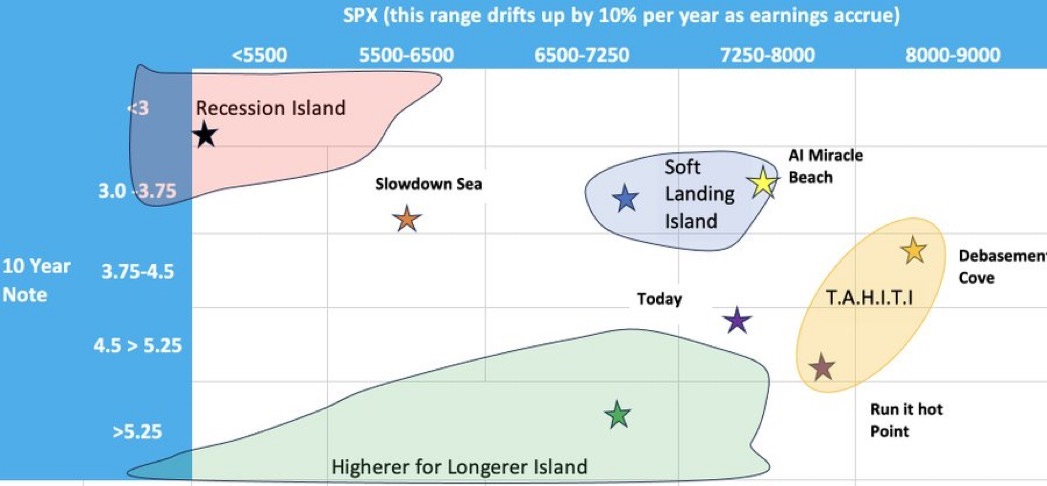
Anyway these asset scenarios linked to the Ancient 8 classic interactions between growth, inflation and financial conditions (another name for driver 3) help consider possibilities. The next step is seeing which of these scenarios is most aggresively priced into markets.
By far scenario 1. Is most reflected in asset prices. Strong real growth expectations have driven stock prices up and gold and bond prices down
But the selloff in both gold and bonds suggest that inflationary pressures remain and an imminent easing is NOT expected.
Perhaps the scenarios that are entirely not discounted is a disinflationary growth scenario with either easing or not. Scenarios 7 and 8. Betting on scenarios 7 and 8 are indeed probably low odds bets but are also close to free.
In the beginning of this year scenario 4 was priced in with high stock prices, bond prices and particularly gold prices and an expectation of growth, disinflation and easing that scenario is much more interesting today but remains nirvana.
My lean
Growth expectations are both very elevated and completely ignore left tails
Inflation expectations are sort of reasonable
Financial Conditions are tightening due to issuance and need for cash to consume and invest while future outlook for risk is quite low and particularly is resting heavily on what has been extremely high diversification benefit within the stock market and across asset markets
I would not want to own the scenario 1 portfolio and am beginning to move My beta and alpha portfolios To anti growth scenarios particularly 5 and 6 while also maintaining substantial commodity exposure (yep it back) for scenario 3. Scenario 2 and 4 seem as remote as 7 and 8.
Nice read but too conservative during a bubble when there is atleast good 2 years left to ride the bubble. Q3 correctiom and next melt up is set to begin sometime in q4. Just rotatate into the next theme with half and be conservative with the other half.
Your piece will become relevant near the end of 2028 when prepare for the exit from bubble topping process. You can read about my short term and long term frame work here https://trademetry.substack.com/p/q3-market-correction-q4-melt-up-next?utm_source=share&utm_medium=android&r=522wtx
The part that stands out is admitting Scenario 1 is priced in but he wouldn’t want to own that portfolio — that’s a rare moment where positioning and conviction visibly diverge instead of pretending they always match.