

There are four reasons to own long term government bonds for your long term savings portfolio. At the peak of the bond bubble (Summer of 2020) there were no reasons at all.
Owning bonds requires four things to be true
Long term bond bonds have an adequate risk premium to cash
Long term bonds have adequate real interest to compensate you vs owning growth assets or consuming
Long term bonds have adequate inflation compensation to offset realized inflation
Long term bonds have meaningful upside in the event growth and inflation is weaker than expectations and that upside allows you to hold lots of growth assets.
Today, three out of four of these requirements are met by the US bond market with inflation compensation as the exception as its not great. The situation in Europe and Japan is even more interesting. Until January 2025 the ROW DM bond market was even less investable than the US Bond market. Because these bond markets offered none of the above 4 things I held no ROW equities. But the ROW DM Bond market has finally caught up to the US bond market and because it did I bought a ton of both bonds and stocks in those markets. NOT JUST BONDS. Bonds and Stocks. That has been a huge win.
Short term outlook on long term bonds.
Full disclosure I am speculatively short US ZB Bond futures. I own 10DTE put spreads which I bought a month ago. They are working nicely and I will either cover the short on a sharp selloff or roll. As a short term trader I am not long bonds and favor selling rallies. Why am I short speculatively? Jeez pretty much every signal I have is bearish bonds. Governement Supply, Corporate Supply, Inflation, Growth, Oil, Hiking cycle not easing, Fed credibility, Fiscal irresponsibility, Global repatriation flows, and of course price momentum. The offset to these bearish things is “value” and contra sentiment.
Despite bearish short term outlook I want to own bonds long term
However, as a long term long only saver who believes it is essential to have most of your savings in a long only diversified portfolio of assets set to your desired risk target, I view bonds as having an essential place in my portfolio. Unlike in the peak of the bond bubble of 2020 and unlike during the longer low interest rate environment in ROW today bonds offer great value. If you have no bonds in your portfolio it is time to add. If you held risk parity or 60/40 through the bond bubble and are sitting on losses today its not the time to puke. I am not asking you to sell equities to buy bonds, I am saying to use cash or even leverage your portfolio (assuming it isnt already leveraged to the hilt with equities) to buy bonds. IF however, you are running leveraged long equities above your risk target YES Sell some equities and buy some bonds (also buy some gold and commodities with equity proceeds but thats for another article)
The Bond Bubble. - DON’T OWN ASSETS IN A BUBBLE! (Hint hint)
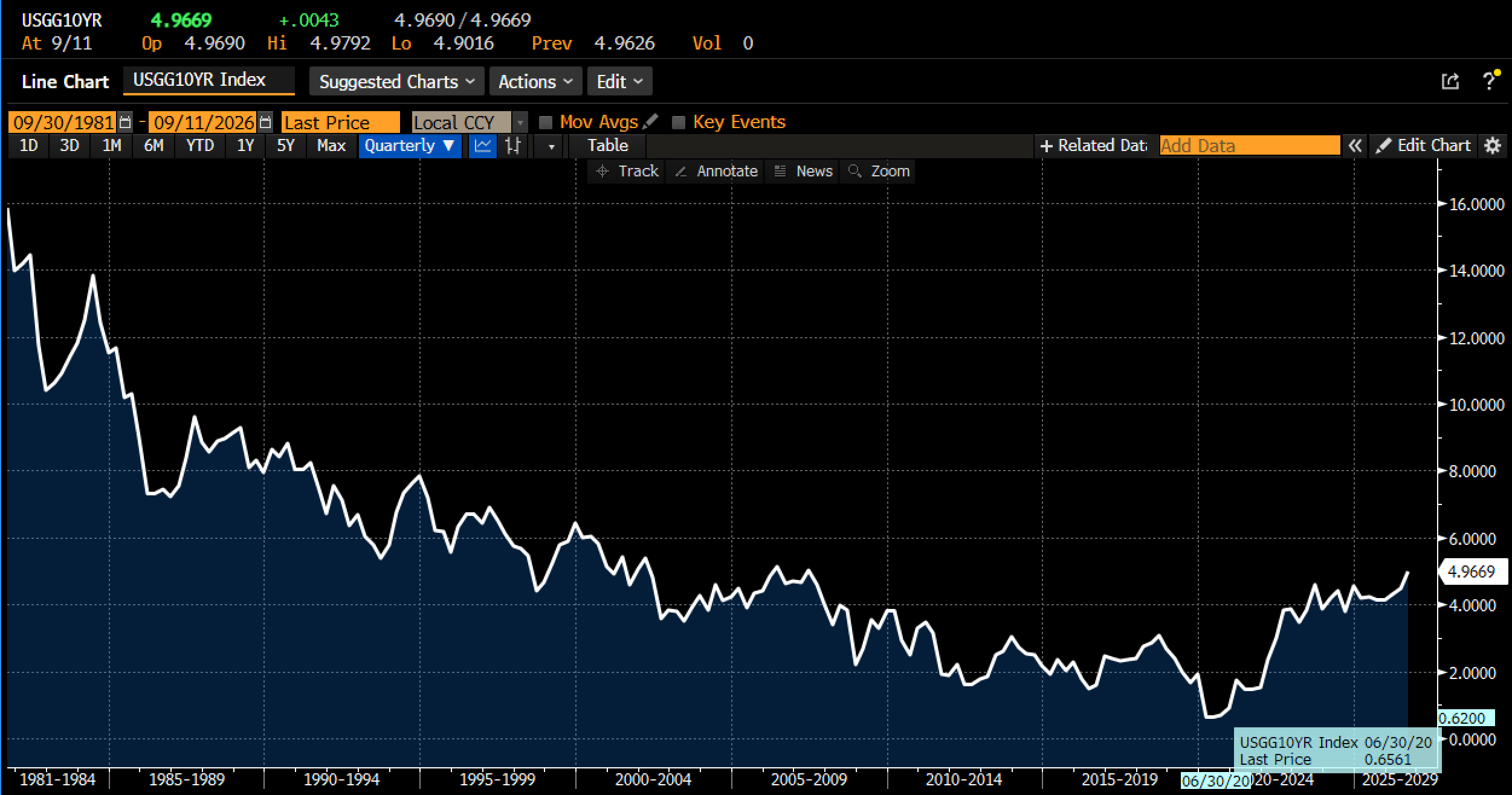
From 1982 to Summer of 2020 the Bond market was in a secular bull market due to Volcker slaying inflation, extremely high yields, decades of disinflation due to globalization and general geopolitical stability, Covid created the parabolic blow off top of the bubble in bonds. The GFC was perhaps the beginning of the bubble in bonds but Covid took bond yields to new lows.
16% 10 year yields fell to 65bp
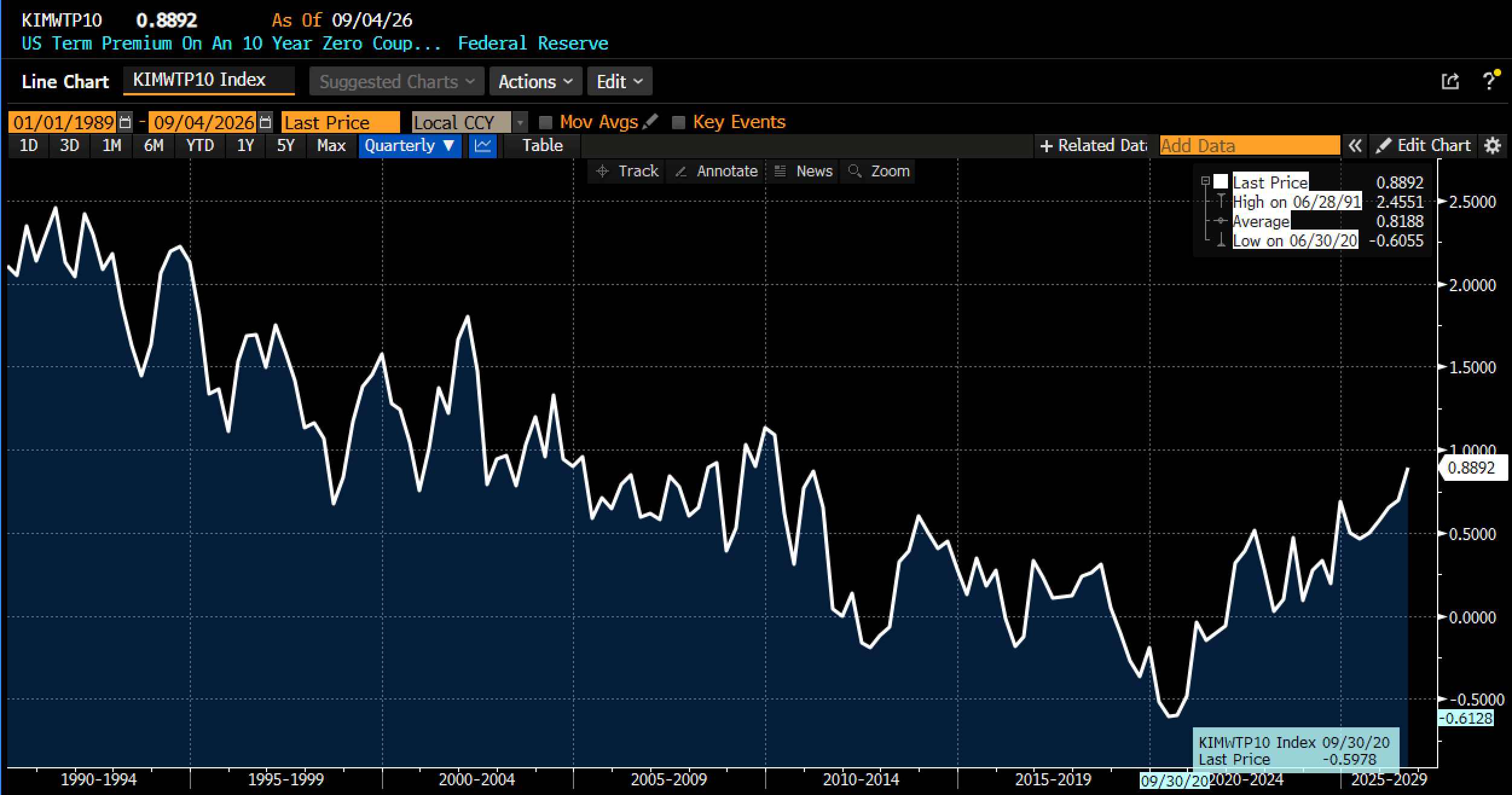
Term Premiums fell from 2% excess return over cash to -50bp. YES Term premium expected negative returns for holding 10 year notes.
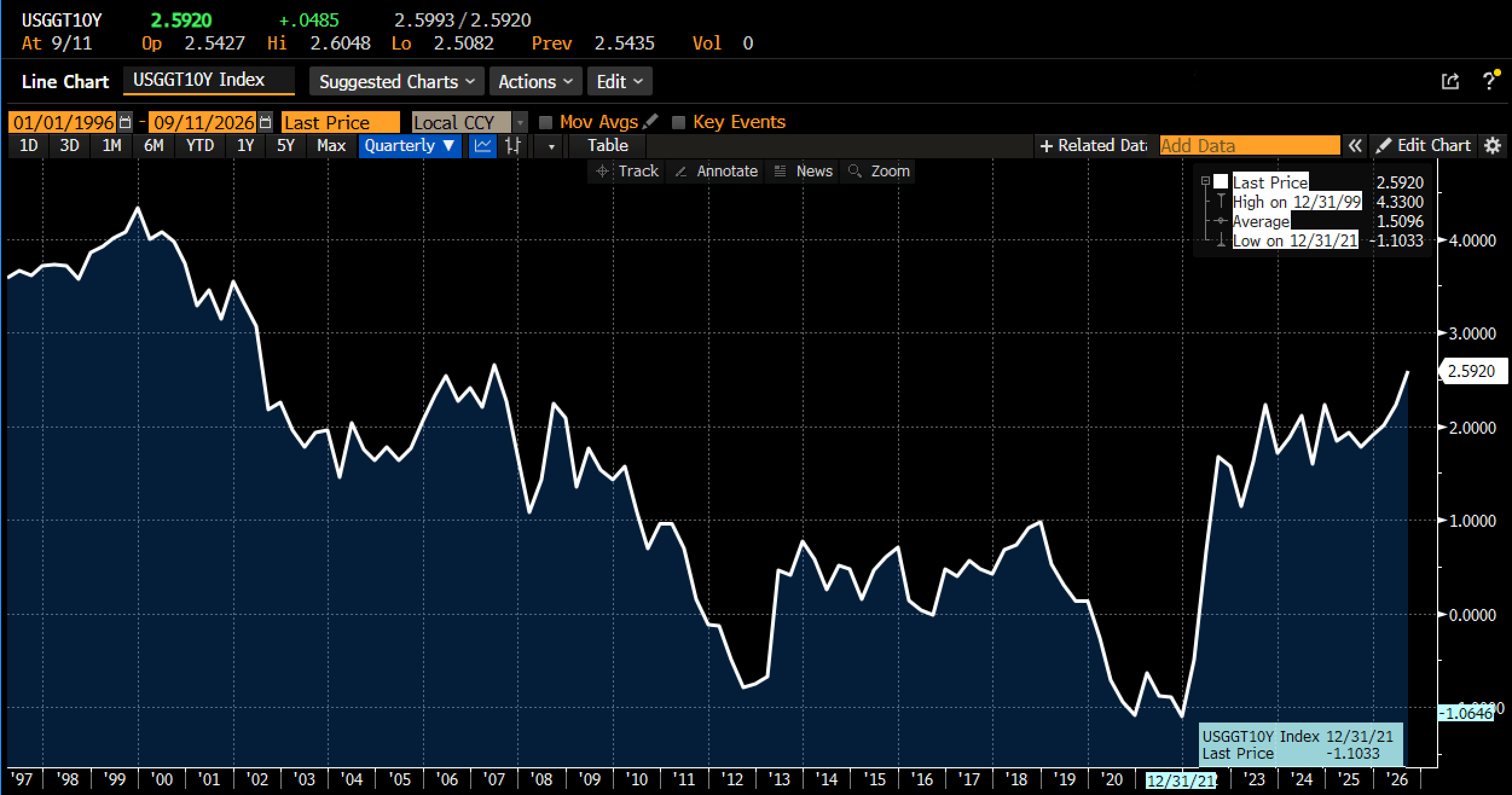
Compensation for holding bonds as compared to growth assets fell from 4% to -1.1%. Essentially pricing in negative future growth! No compensation and in fact bonds were so bid that they paid compensation to be short them and yet no one was.
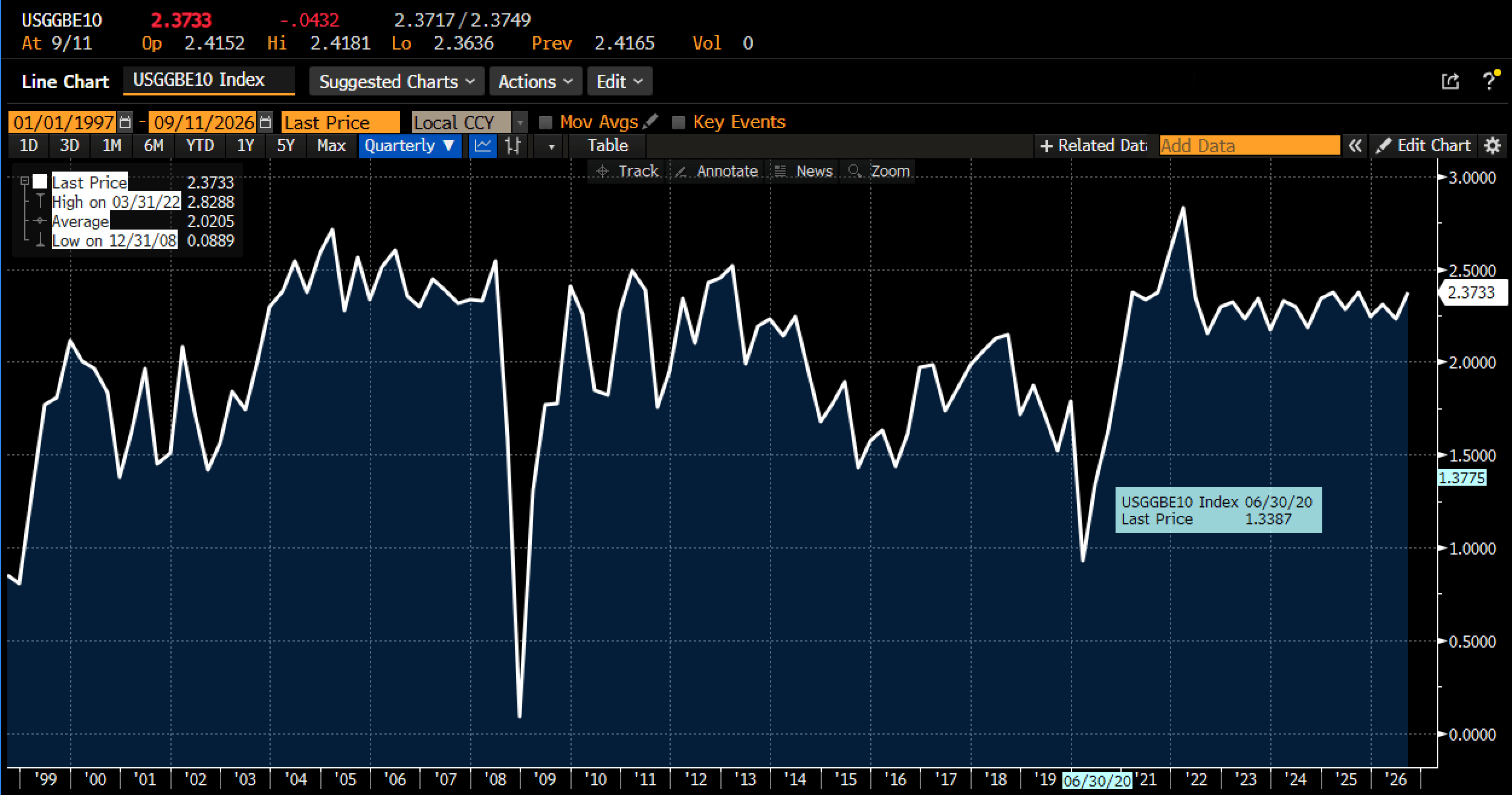
Inflation compensation was 130bp providing less compensation than the Fed was targetting!
Scroll back up to the top. Literally none of the reasons to own bonds as an asset in a long term portfolio existed. Perhaps the biggest one was the absolute uselessness of holding bonds for capital appreciation in the event of a a disinflationary or weak growth envirnonment. My approach to beta in that environment was to own less of everything but no bonds.
The Global bubble didn’t pop as quickly as the US Bubble
While the US bubble popped rapidly and yields climbed to more investable levels by the end of 2022 the ROW DM bubble made global bonds (and from a risk parity standpoint for equities and currency standpoint in general) made the countries uninvestable. Finally by the end of 2024 Global ROW risk parity became competitive with US risk parity. I got out of overweight US based on this fact and am now equal weight global risk parity vs US and looking to add more ROW particularly Japan stocks and bonds.
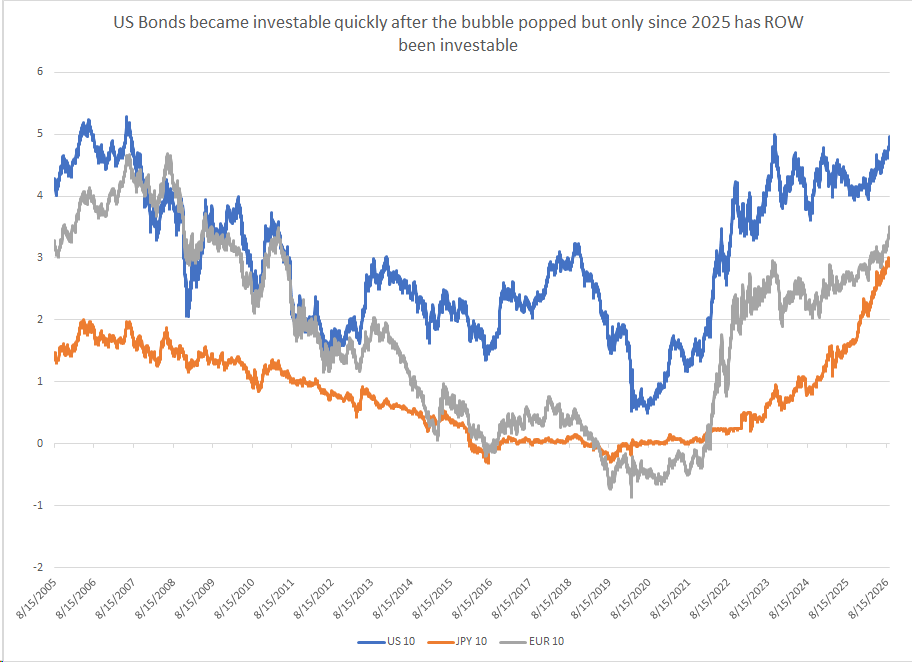
Today - Bonds are investable long term.
Short term there is a lot of headwind for bonds. I get it. As an outright stand alone investment in the face of all the bearish bond narratives I don’t expect great bond returns vs cash. That said they do provide. solid real rates, solid excess return over cash (term premium), and meh but not awful inflation compensation. BUT most importantly they provide real capital appreciation potential in the unlikely short term event but certain long term outcome that the economy cools. Do not sleep on the idea that ROW bonds also look good based on all these factors. Look back up at the various charts above in the bubble section and compare current compensation with long history. Not bad tbh.US equities by themselves is just a dumb portfolio.
The 60/40 Strikes back
Holding any portfolio needs a risk target. Bonds are less risky than stocks so choosing to sell some stocks and buy bonds is a conscious choice to lower the risk of your portfolio which will reduce your long term expected return. I am not advocating doing that in this article. What matters is holding a portfolio with the best risk adjusted return at your risk target. I happen to believe in an “All Weather” sort of configuration that has equal risk weight of bonds, and stocks, and has additional diversification by holding gold and commodities. When doing that if ones risk target is Equities Risk you need leverage. That is another topic. Here is a 101 I wrote from twitter.

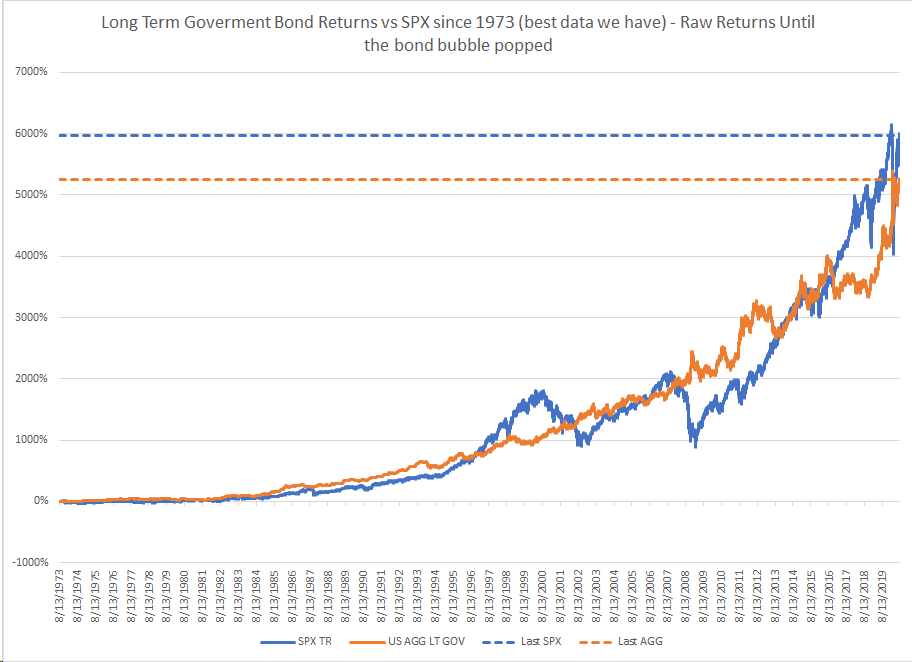
However since 1973 until the bond bubble peaked and despite the extreme high yields in the late 70’s early 80’s long term bonds without leverage almost matched the SPX total return. But were also 60% as risky
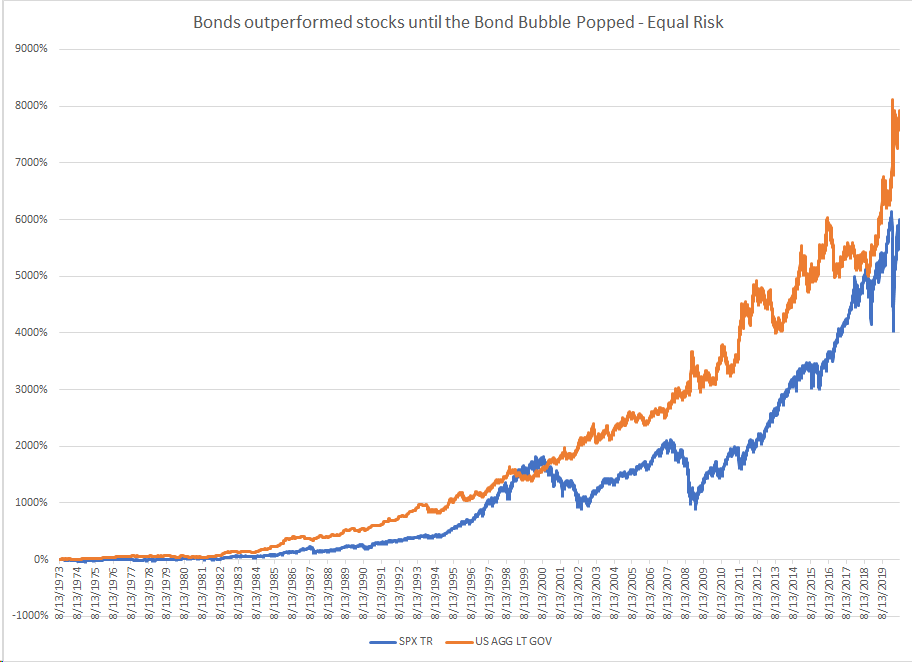
At equal risk bonds crushed equities.
A modestly leveraged portfolio of 75% Long term bonds and 50% Equities was fantastic. Drawdowns were softer and returns were better.
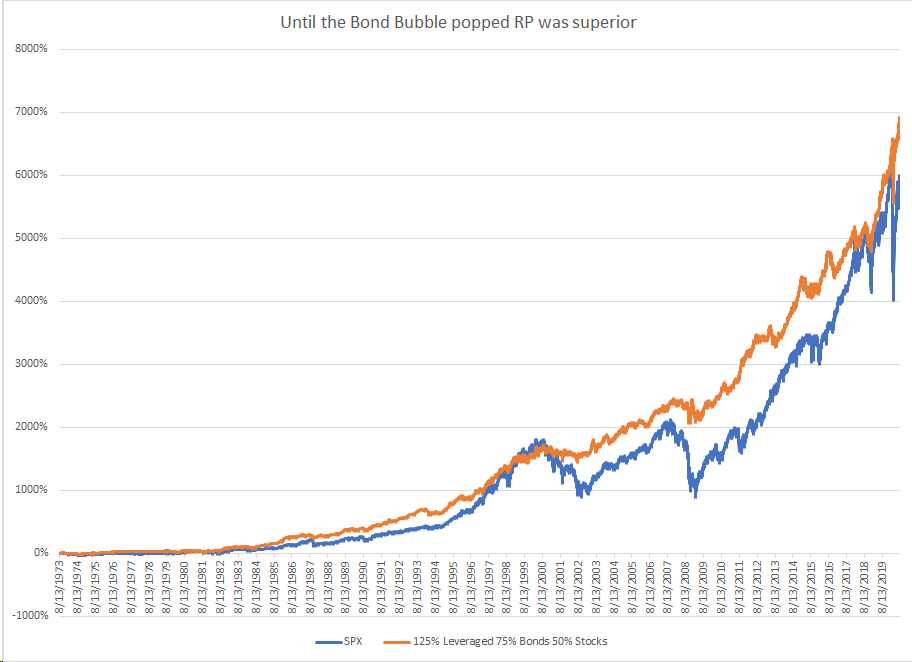
Then the bubble popped. But again there was no reason to own bonds in summer of 2020. It was obvious in hindsight but with even a basic understanding of future returns and value in a diversified portfolio it was obvious in foresight. What happened to Risk Parity and 60/40 was complancency.
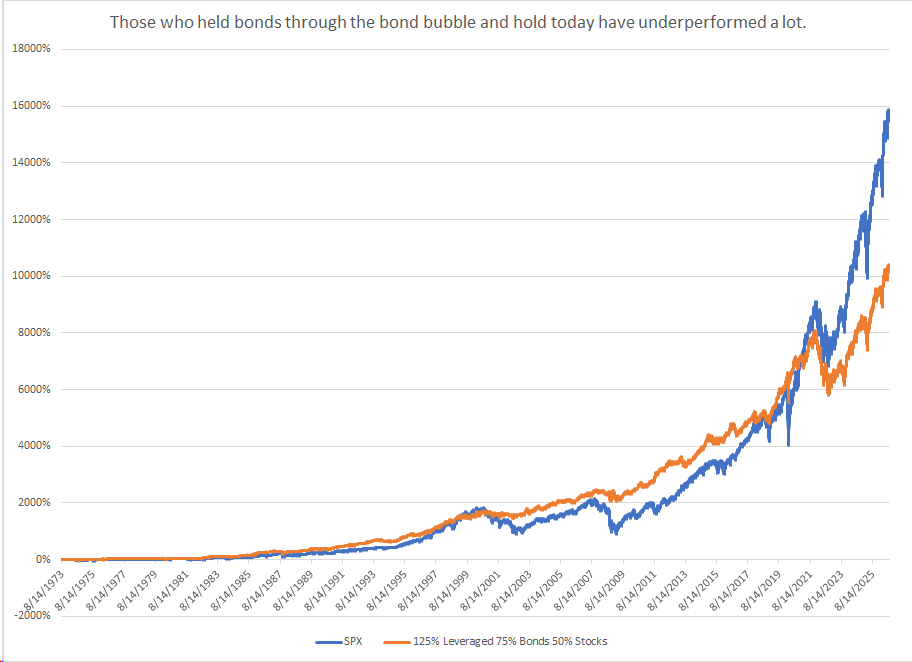
Is the bond market in a bubble today? Hell no. Is the stock market? I think so but thankfully holding a nice slug of bonds allows me to continue to hold equities if the bubble continues to inflate. I have a DSR I have made public which provides my view of bubbles in general and what to do about them.
Holding assets in a bubble out of complacency when they have limited risk adjusted returns and serve no purpose in balancing a portfolio is a bad idea.
Selling your bonds today or not holding bonds today based on the bad returns experience during the bubble of 2020 is like dumping your stocks in 2002, 2009, or 2020.
Short term I am both adding to bonds and in particular adding both stocks and bonds in the ROW in my long term portfolio and short bonds as a speculative trade. Its hard to have two opposing thoughts in your mind at once but that’s what I am doing. My short term view can change rapidly. One leg down and i could be max long bonds speculatively. One rip up and I could be max short. But my beta portfolio is set up for all outcomes and is blessed by bonds that check all the long term boxes.
I find little fault with your logic, but your four requirements are all demand-side, single-generating-process metrics. They answer: "Given historical bond market dynamics, is the compensation adequate for a long-term saver?" Every requirement assumes the bond market's return distribution is drawn from one population; the historical one where term premium, real rates, breakevens, and convexity are the sufficient statistics.
My point (expanded on below) is that the current bond market has at least four distinct generating processes operating simultaneously, and your framework collapses them into one:
Process 1 — Classical risk premium (your model). The term premium normalizes, real rates are positive, and bonds compensate for duration. This is the process your four requirements measure. It says: buy.
Process 2 — Reserve/trust erosion. ROW central banks and sovereign wealth funds pulling back from Treasuries not because of yield inadequacy but because of counterparty mistrust of the US fiscal and institutional trajectory. This generating process has nothing to do with term premium or real rates. It operates on a completely different parameter space: geopolitical alignment, sanctions risk, dollar weaponization history, institutional credibility. Your framework literally cannot see this process because none of your four requirements capture it. A bond can meet all four requirements and still get sold by a reserve manager who no longer trusts the issuer.
Process 3 — Fiscal dominance. Accelerating deficits with no mechanism for correction. No adults in the room. The supply of Treasuries is growing faster than any demand-side analysis can absorb. You list "government supply" as one of your 10 short-term bearish factors, but you treat it as cyclical; a short-term headwind within a structurally sound long-term asset. Fiscal dominance says it's not cyclical. It's a regime change in the generating process itself. The supply trajectory is not mean-reverting. It's accelerating. And every additional dollar of issuance changes the return distribution of every existing bond in ways that the historical backtests (1973-present) never encountered at this scale.
Process 4 — Energy/geopolitical supply shock. Trump/Hegseth policy driving energy costs structurally higher. This attacks your weakest requirement (inflation compensation) from a direction your framework treats as exogenous noise rather than a persistent generating process. If oil isn't cycling; if it's being structurally repriced by policy incompetence, then the "meh but not awful" assessment on inflation comp isn't just the weak link. It's the link that's actively corroding.
The Homogeneous Population Fallacy diagnosis:
When you demix these four processes, the picture is radically different:
Process DS Framework Sees It? Direction for Bonds Persistence
1. Classical risk premium YES — this is his entire model Bullish Mean-reverting (his backtest works)
2. Reserve/trust erosion NO — outside his parameter space Bearish Structural / accelerating
3. Fiscal dominance Partially — listed as short-term factor Bearish Structural / accelerating
4. Energy policy shock Partially — via inflation comp caveat Bearish Policy-dependent, not cyclical
You are modeling Process 1, acknowledging Processes 3 and 4 as short-term headwinds, and seem to be ignoring Process 2. Your framework is adequate if and only if Process 1 dominates the mixture. We may be in a regime where Processes 2-4 collectively outweigh Process 1, and they've never co-occurred at this intensity in your backtest window.
The 1973-present backtest is the tell. Your strongest empirical evidence, "unlevered long bonds nearly matched SPX at 60% of the risk" is drawn from a period when the US was the unquestioned reserve issuer, deficits were intermittently controlled, energy shocks were temporary, and ROW had no alternative to Treasuries. Every single one of those conditions is now degraded or reversing. The backtest is a single-population sample from a regime that may no longer be the generating process.
Whatever. I was just trying to engage. I have already added RFIX to my own portfolio as a high-convexity bet on bonds, since the PFIX/RFIX ratios have been compressing and other metrics (Diado first order coupling metrics) suggest the switchover to the bond side might be sharp rather than gradual